Samsung
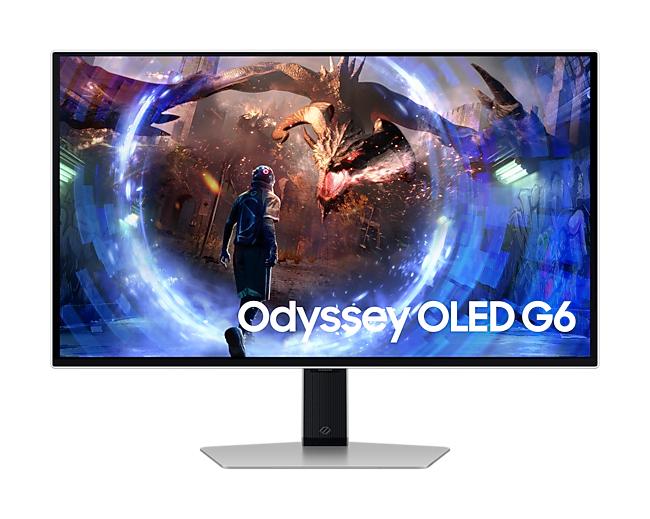
Samsung Odyssey OLED G6 (LS27FG602S)
$999.99
Released 2024-08
Best Computer Monitors · head-to-head
A sourced, side-by-side comparison. ASUS ROG Swift OLED PG27AQDP is cheaper at $699. Every spec and price links to its source.
Samsung
$999.99
Released 2024-08

ASUS
$699Cheaper
Released 2024-09
The Samsung Odyssey OLED G6 (LS27FG602S) wins 1 of the 1 specs we compare head to head; the other wins 0. The ASUS ROG Swift OLED PG27AQDP is the cheaper at $699. Get the Samsung Odyssey OLED G6 (LS27FG602S) for the stronger spec sheet, the ASUS ROG Swift OLED PG27AQDP to spend less.
As an Amazon Associate we earn from qualifying purchases. Prices verified at capture; live price may differ.
The numbers that decide it, drawn to scale — longer bar wins, the accent bar is the stronger figure.
✓ marks the stronger figure where "more" — or "less", for price and weight — is unambiguously better.
| Spec | Samsung Odyssey OLED G6 (LS27FG602S) | ASUS ROG Swift OLED PG27AQDP |
|---|---|---|
| US price | $999.99 | $699 |
| Brand | Samsung | ASUS |
| Released | 2024-08 | 2024-09 |
| Size (in) | 27 | 27 |
| Resolution | 2560x1440 | 2560x1440 |
| Panel type | OLED | WOLED |
| Refresh (Hz) | 500 | 480 |
| Response ms | 0.03 | 0.03 |
| HDR | VESA DisplayHDR 500 | VESA DisplayHDR True Black 400 |
| Ports | 1x DP 1.4, 2x HDMI 2.1 | 1x DP 1.4, 2x HDMI 2.1, 2x USB-A 3.2 Gen 1 |
| Adaptive sync | AMD FreeSync Premium Pro, NVIDIA G-Sync Compatible | AMD FreeSync Premium, NVIDIA G-Sync Compatible |
| Release | 2024-08 | 2024-09 |
Sources — Samsung Odyssey OLED G6 (LS27FG602S): newegg.com (verified 2026-06-15). ASUS ROG Swift OLED PG27AQDP: rog.asus.com (verified 2026-09-21).
Where the two actually differ on the specs we track (5 of 8). Matching specs are omitted.
Sourced tester consensus for each — the "what people who used it think" layer, not just specs.
Three whitelisted outlets (Tom's Hardware, PCWorld, TechRadar) each reviewed this exact 27-inch 500Hz QD-OLED (S27FG60/G60SF). All rate it a top-tier OLED for motion clarity, speed, and color, while dinging its 1440p sharpness, missing USB-C, and limited SDR presets. Tom's Hardware and PCWorld ran lab measurements; TechRadar was hands-on with no independent numbers. Several Tom's Hardware quotes/measurements sat on later review pages not captured by the fetch and were dropped. (3 sourced reviews, 2 lab-tested.)
Praised: Blistering 500Hz motion clarity with no perceptible input lag; Vibrant, wide-gamut, accurate color (98-108% DCI-P3); Premium metal build and slick design.
Flagged: No USB-C connectivity; Only 1440p; sharpness weak for the price; Limited/disappointing SDR calibration and presets.
One whitelisted tester source (Tom's Hardware, lab-measured, published 2024-09-04) was verified for the ASUS ROG Swift PG27AQDP. All four quotes and all eight measured values were re-confirmed verbatim against the review. Tom's Hardware calls the PG27AQDP the pinnacle of premium gaming monitors, measuring a 400-nit SDR peak, 1,300-nit HDR highlights, 709-nit 25% HDR window, over 97% DCI-P3, and 15ms total input lag at a tested 480Hz QHD. (1 sourced review, 1 lab-tested.)
Praised: Class-leading motion clarity and gaming performance at 480Hz QHD; Wide color gamut, over 97% DCI-P3 coverage; Low total input lag (15ms) despite full QHD resolution.
Flagged: SDR peak brightness limited to a measured 400 nits, typical OLED ceiling; Input lag (15ms) does not match the record-setting 11ms of the FHD-mode PG32UCDP.