Garmin
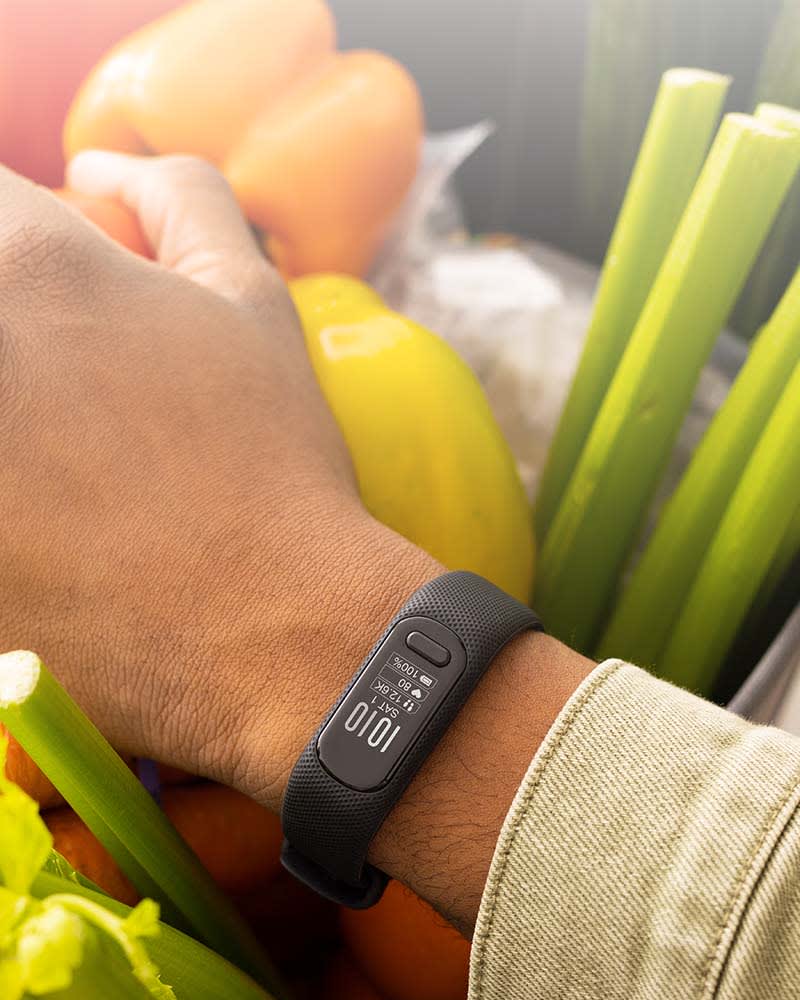
Garmin Vivosmart 5
$149.99Cheaper
Released 2022-04
Best Fitness Trackers · head-to-head
A sourced, side-by-side comparison. Garmin Vivosmart 5 is cheaper at $149.99. Every spec and price links to its source.
Garmin
$149.99Cheaper
Released 2022-04

Ultrahuman
$349
Released 2023-09
On the specs we track, they're closely matched. The Garmin Vivosmart 5 is the cheaper at $149.99.
As an Amazon Associate we earn from qualifying purchases. Prices verified at capture; live price may differ.
✓ marks the stronger figure where "more" — or "less", for price and weight — is unambiguously better.
| Spec | Garmin Vivosmart 5 | Ultrahuman Ring AIR |
|---|---|---|
| US price | $149.99 US MSRP at launch Apr 20 2022. | $349 |
| Brand | Garmin | Ultrahuman |
| Released | 2022-04 | 2023-09 |
| Form factor | band | ring |
| Display | OLED 0.84in monochrome | — |
| Battery days | 7 | 6 |
| Gps | No | No |
| Spo2 | Yes | Yes |
| Ecg | No | No |
| Subscription required | No | No |
| Water resistance (m) | 50 | 100 |
| Release | 2022 | 2023 |
Sources — Garmin Vivosmart 5: garmin.com (verified 2026-06-15). Ultrahuman Ring AIR: androidcentral.com (verified 2026-06-15).
Where the two actually differ on the specs we track (3 of 8). Matching specs are omitted.
Sourced tester consensus for each — the "what people who used it think" layer, not just specs.
Three whitelisted testers (DC Rainmaker, Tom's Guide, TechRadar) field-tested the exact Vivosmart 5. All praise its accurate optical heart rate, ~7-day battery (with all-day SpO2 off), and free no-subscription Garmin Connect data, but flag the dated monochrome screen and missing onboard GPS. DC Rainmaker calls it a rare miss and overpriced versus the $149 Fitbit Charge 5; TechRadar calls it excellent for everyday wellbeing; Tom's Guide rates it a good tracker that falls short without GPS. (3 sourced reviews, 3 lab-tested.)
Praised: Accurate, responsive optical heart rate in workout/interval tests; Long ~7-day battery life (with all-day SpO2 disabled); Deep Garmin Connect data with no subscription paywall (unlike Fitbit).
Flagged: No onboard GPS; relies on phone, causing distance errors on longer routes; Dated monochrome screen, hard to read outdoors/on the move; All-day SpO2 monitoring drains battery drastically (to ~3-4 days).
Two whitelisted testers (TechRadar, Tom's Guide) wore the Ring Air for a month and 60 days respectively, both benchmarking it against Apple Watch and Oura. Both praise its featherweight comfort, detailed data and no subscription; both flag easy scratching. Verdicts converge: a capable, data-heavy ring for enthusiasts. No RTINGS lab data exists. (2 sourced reviews, 2 lab-tested.)
Praised: Extremely lightweight (2.4-3.6g) and comfortable, even for sleep; Heart-rate/steps/sleep data tracks closely with Apple Watch and Oura references; No mandatory subscription to view your data.
Flagged: Scratches easily, especially the matte black finish, within weeks; Overwhelming volume of data; app less user-friendly than Oura; No screen means you must open the app for everything.