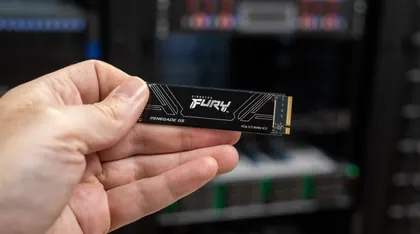
Kingston
Kingston FURY Renegade G5
$499.99
Released 2025
Best Internal Ssds · head-to-head
A sourced, side-by-side comparison. Seagate FireCuda 540 is cheaper at $189.99. Every spec and price links to its source.
Kingston
$499.99
Released 2025
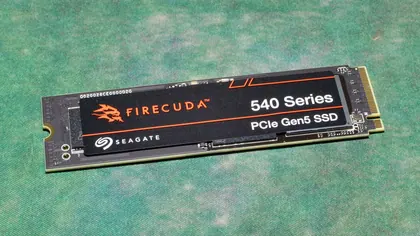
Seagate
$189.99Cheaper
Released 2023
The Kingston FURY Renegade G5 wins 2 of the 2 specs we compare head to head; the other wins 0. The Seagate FireCuda 540 is the cheaper at $189.99. Get the Kingston FURY Renegade G5 for the stronger spec sheet, the Seagate FireCuda 540 to spend less.
As an Amazon Associate we earn from qualifying purchases. Prices verified at capture; live price may differ.
The numbers that decide it, drawn to scale — longer bar wins, the accent bar is the stronger figure.
✓ marks the stronger figure where "more" — or "less", for price and weight — is unambiguously better.
| Spec |  Kingston FURY Renegade G5 Kingston FURY Renegade G5 |  Seagate FireCuda 540 Seagate FireCuda 540 |
|---|---|---|
| US price | $499.99 | $189.99 |
| Brand | Kingston | Seagate |
| Released | 2025 | 2023 |
| Capacity options (TB) | 1, 2, 4 | 1, 2 |
| Form factor | M.2 2280 | M.2 2280 |
| Interface | PCIe 5.0 x4 NVMe | PCIe 5.0 x4 NVMe |
| Seq read (Mbps) | 14800 | 10000 |
| Seq write (Mbps) | 14000 | 10000 |
| Random read kiops | — | — |
| Random write kiops | — | — |
| Nand type | 3D TLC | TLC |
| Has dram cache | Yes | Yes |
| Endurance tbw | 1000 | 1000 |
| Warranty years | 5 | 5 |
Sources — Kingston FURY Renegade G5: storagereview.com (verified 2026-07-11). Seagate FireCuda 540: seagate.com (verified 2026-07-11).
Where the two actually differ on the specs we track (4 of 11). Matching specs are omitted.
Sourced tester consensus for each — the "what people who used it think" layer, not just specs.
Three whitelisted labs benchmarked this PCIe 5.0 drive - StorageReview and Tom's Hardware on the 2TB, Notebookcheck on the 8TB. All rate it among the fastest Gen5 SSDs, with StorageReview and Notebookcheck measuring chart-topping sequential throughput (~14,600-14,890 MB/s), and Tom's Hardware calling it a faithful followup 'bringing much higher performance.' Every surviving source flags premium pricing above competing Gen5 SSDs. (TechPowerUp was dropped in verification - its page as read contained no confirmable quotes or measurements.) (3 sourced reviews, 3 lab-tested.)
Praised: Class-leading sequential read/write throughput (~14,600-14,890 MB/s measured); Power efficiency and low heat output from the 6nm SM2508 controller; Stable sustained performance with no throttling when adequately cooled.
Flagged: Premium pricing above competing Gen5 SSDs; Offers little to distinguish it from rival high-end SSDs on real-world speed/value; Ships with no cooler; needs at least a passive heatsink to sustain peak load.
Three whitelisted testers hands-on benchmarked the 2 TB FireCuda 540: Tom's Hardware and StorageReview at its 2023 launch, and TechPowerUp in a 2025 re-review. Consensus: a fast PCIe 5.0 drive with high sequential throughput, class-leading sustained/full-drive write speeds, and a standout support package (high TBW endurance plus 3-year data recovery), offset by poor power efficiency, high heat, and a hard requirement for a heatsink to avoid throttling. Both later-lens findings and StorageReview's enterprise tests show it only marginally leads top Gen 4 drives in real use and is weak in some write workloads. (3 sourced reviews, 3 lab-tested.)
Praised: High sequential throughput / impressive transfer rates; Class-leading sustained and full-drive write performance; Strong warranty, high TBW endurance and 3-year data recovery service.
Flagged: Poor power efficiency and high heat output; Requires cooling; throttles without a heatsink; Does not fully leverage Gen 5 - only marginally faster than top Gen 4 drives in real use, and weak in some write tests.