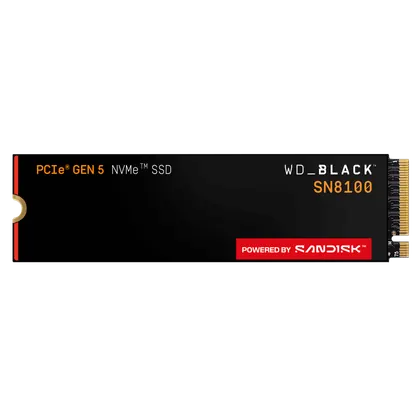
Western Digital
Western Digital WD_Black SN8100
$179.99Cheaper
Released 2025-05
Best Internal Ssds · head-to-head
A sourced, side-by-side comparison. Western Digital WD_Black SN8100 is cheaper at $179.99. Every spec and price links to its source.
Western Digital
$179.99Cheaper
Released 2025-05
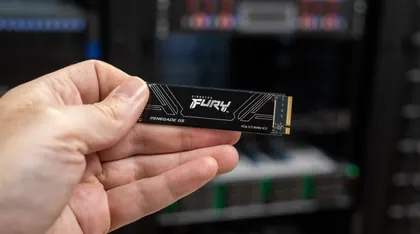
Kingston
$499.99
Released 2025
The Western Digital WD_Black SN8100 wins 1 of the 1 specs we compare head to head; the other wins 0. The Western Digital WD_Black SN8100 is the cheaper at $179.99. The Western Digital WD_Black SN8100 both leads on specs and costs less — the straightforward pick.
As an Amazon Associate we earn from qualifying purchases. Prices verified at capture; live price may differ.
The numbers that decide it, drawn to scale — longer bar wins, the accent bar is the stronger figure.
✓ marks the stronger figure where "more" — or "less", for price and weight — is unambiguously better.
| Spec |  Western Digital WD_Black SN8100 Western Digital WD_Black SN8100 |  Kingston FURY Renegade G5 Kingston FURY Renegade G5 |
|---|---|---|
| US price | $179.99 | $499.99 |
| Brand | Western Digital | Kingston |
| Released | 2025-05 | 2025 |
| Capacity options (TB) | 1, 2, 4, 8 | 1, 2, 4 |
| Form factor | M.2 2280 | M.2 2280 |
| Interface | PCIe 5.0 x4 NVMe | PCIe 5.0 x4 NVMe |
| Seq read (Mbps) | 14900 | 14800 |
| Seq write (Mbps) | 14000 | 14000 |
| Random read kiops | 2300 | — |
| Random write kiops | 2300 | — |
| Nand type | TLC | 3D TLC |
| Has dram cache | Yes | Yes |
| Endurance tbw | — | 1000 |
| Warranty years | 5 | 5 |
Sources — Western Digital WD_Black SN8100: sandisk.com (verified 2026-07-11). Kingston FURY Renegade G5: storagereview.com (verified 2026-07-11).
Where the two actually differ on the specs we track (3 of 11). Matching specs are omitted.
Sourced tester consensus for each — the "what people who used it think" layer, not just specs.
Three whitelisted labs (Tom's Hardware, StorageReview, PCWorld) benchmarked the 2TB WD_Black SN8100 and rate it among the fastest consumer Gen5 SSDs tested, with class-leading synthetic throughput and top-tier random IOPS plus strong power efficiency. Tom's Hardware and PCWorld flag premium pricing; PCWorld also hit write-speed inconsistency on an older motherboard that vanished on a new test bed. (TechPowerUp's review was dropped because only its intro/spec page was retrievable, leaving no verifiable quotes or measurements.) (3 sourced reviews, 3 lab-tested.)
Praised: Fastest consumer Gen5 SSD tested; record-setting synthetic throughput and top-tier random-read IOPS; Power-efficient and runs cool (peak under 50 degrees C in PCWorld's testing); Excellent all-around real-world performance, including gaming, DirectStorage and AI-model loading.
Flagged: Premium pricing versus Gen4 and rival Gen5 drives; Real-world gains over the best drives are small; overkill for most users; Write-speed inconsistency / severe drops on an older motherboard slot.
Three whitelisted labs benchmarked this PCIe 5.0 drive - StorageReview and Tom's Hardware on the 2TB, Notebookcheck on the 8TB. All rate it among the fastest Gen5 SSDs, with StorageReview and Notebookcheck measuring chart-topping sequential throughput (~14,600-14,890 MB/s), and Tom's Hardware calling it a faithful followup 'bringing much higher performance.' Every surviving source flags premium pricing above competing Gen5 SSDs. (TechPowerUp was dropped in verification - its page as read contained no confirmable quotes or measurements.) (3 sourced reviews, 3 lab-tested.)
Praised: Class-leading sequential read/write throughput (~14,600-14,890 MB/s measured); Power efficiency and low heat output from the 6nm SM2508 controller; Stable sustained performance with no throttling when adequately cooled.
Flagged: Premium pricing above competing Gen5 SSDs; Offers little to distinguish it from rival high-end SSDs on real-world speed/value; Ships with no cooler; needs at least a passive heatsink to sustain peak load.