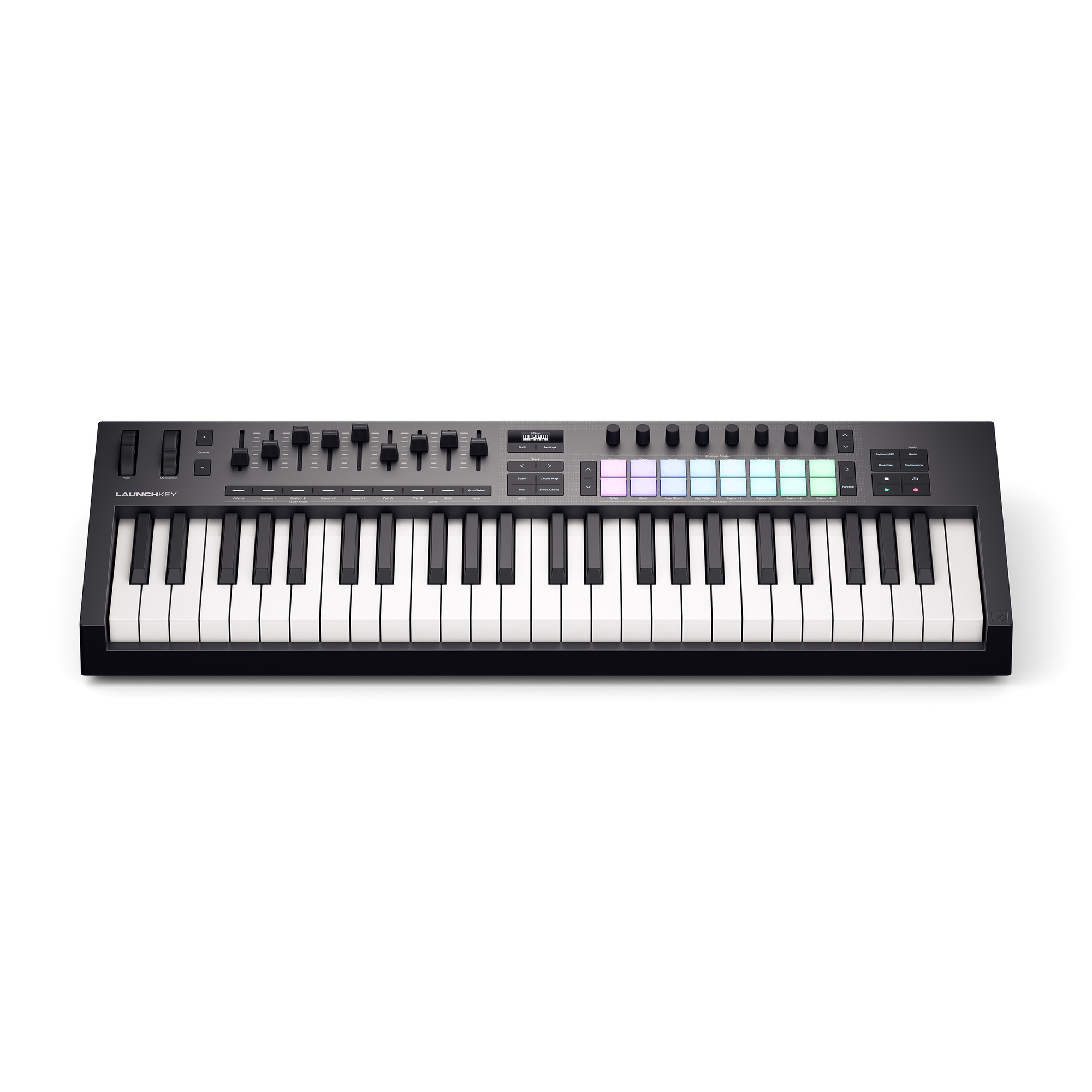
Novation
Launchkey 49 MK4
$279.99
Released 2024-08
Best MIDI Keyboards · head-to-head
A sourced, side-by-side comparison. nanoKEY2 is cheaper at $99.99. Every spec and price links to its source.
Novation
$279.99
Released 2024-08

Korg
$99.99Cheaper
Released 2011
On the specs we track, they're closely matched. The nanoKEY2 is the cheaper at $99.99.
As an Amazon Associate we earn from qualifying purchases. Prices verified at capture; live price may differ.
✓ marks the stronger figure where "more" — or "less", for price and weight — is unambiguously better.
| Spec | Launchkey 49 MK4 | nanoKEY2 |
|---|---|---|
| US price | $279.99 | $99.99 |
| Brand | Novation | Korg |
| Released | 2024-08 | 2011 |
| Keys | 49 | 25 |
| Key type | semi_weighted | synth |
| Drum pads | 16 | 0 |
| Knobs | 8 | 0 |
| Faders | 9 | 0 |
| Aftertouch | No | No |
| Connection | usb_midi_din | usb |
| Bundled software | Ableton Live Lite, Cubase LE, GForce Oberheim SEM, Klevgrand plugins, NI Komplete Select, Melodics | Korg Kontrol Editor |
| Release | 2024 | 2011 |
Sources — Launchkey 49 MK4: us.novationmusic.com (verified 2026-06-19). nanoKEY2: korg.com (verified 2026-06-19).
Where the two actually differ on the specs we track (7 of 8). Matching specs are omitted.
Sourced tester consensus for each — the "what people who used it think" layer, not just specs.
Two whitelisted testers reviewed the Launchkey 49 MK4 hands-on: MusicRadar covering the 49 and 61 together, and Sound on Sound covering the whole MK4 range with 49/61-specific commentary. Both reach a positive verdict. Shared praise centres on the comprehensive control surface and tight Ableton Live / DAW integration. MusicRadar additionally singles out the playable semi-weighted keys and the software bundle; Sound on Sound additionally praises the creative arpeggiator and Chord Map modes. Both flag readability of the small OLED / under-labelled controls and the chunky, heavier build of the larger 49/61. Neither ran measurements, so all findings are qualitative. (2 sourced reviews.)
Praised: Playable, semi-weighted full-size keys; Comprehensive control surface with faders, encoders, pads and central OLED; Tight Ableton Live / DAW integration.
Flagged: Small OLED display and control labels that could be larger or better illuminated; The larger 49/61 are chunky and heavier than the smaller range models; Thin documentation for third-party DAW/plug-in control.
One verified review of this exact model survives: MusicRadar (by Computer Music), 1 June 2011. It rates the nanoKey2 a clear improvement on the original nanoKey — velocity response is now consistent regardless of where you strike the key, the keys no longer catch on the casing, and the overall feel is much better — while noting the action stays very light and a little awkward, and that the original's CC Mode was removed. The verdict is 'The new hardware looks and feels better, though some may be disappointed that certain features have been left behind.' All judgements are subjective; no measurements are published. (1 sourced review.)
Praised: Velocity response is far more consistent than the original nanoKey, and keys no longer stick against the edge of the casing; Improved design and build with notably better key feel, at a highly affordable price (listed at £48 / $65); Class-compliant USB-powered operation across the nanoSeries 2 — no drivers or external power supply needed.
Flagged: The original nanoKey's CC Mode was removed, so functionality was lost from the first series rather than the feature-set being expanded; Very light, non-traditional key action still feels a little awkward and takes getting used to; Deeper settings such as velocity curve and pitch/mod button timing still require the separate Kontrol Editor software.