ASUSTOR
ASUSTOR Lockerstor 4 Gen3 (AS6804T)
$1319.99
Released 2024
Best NAS Devices · head-to-head
A sourced, side-by-side comparison. UGREEN NASync DXP4800 Plus is cheaper at $699.99. Every spec and price links to its source.
ASUSTOR
$1319.99
Released 2024
UGREEN
$699.99Cheaper
Released 2024
The ASUSTOR Lockerstor 4 Gen3 (AS6804T) wins 1 of the 1 specs we compare head to head; the other wins 0. The UGREEN NASync DXP4800 Plus is the cheaper at $699.99. Get the ASUSTOR Lockerstor 4 Gen3 (AS6804T) for the stronger spec sheet, the UGREEN NASync DXP4800 Plus to spend less.
As an Amazon Associate we earn from qualifying purchases. Prices verified at capture; live price may differ.
The numbers that decide it, drawn to scale — longer bar wins, the accent bar is the stronger figure.
✓ marks the stronger figure where "more" — or "less", for price and weight — is unambiguously better.
| Spec | ASUSTOR Lockerstor 4 Gen3 (AS6804T) | UGREEN NASync DXP4800 Plus |
|---|---|---|
| US price | $1319.99 | $699.99 |
| Brand | ASUSTOR | UGREEN |
| Released | 2024 | 2024 |
| Bays | 4 | 4 |
| CPU | AMD Ryzen Embedded V3C14 (4-core, 2.3–3.8 GHz) | Intel Pentium Gold 8505 (5-core, up to 4.4 GHz) |
| RAM (GB) | 16 | 8 |
| Max capacity (TB) | 96 | 96 |
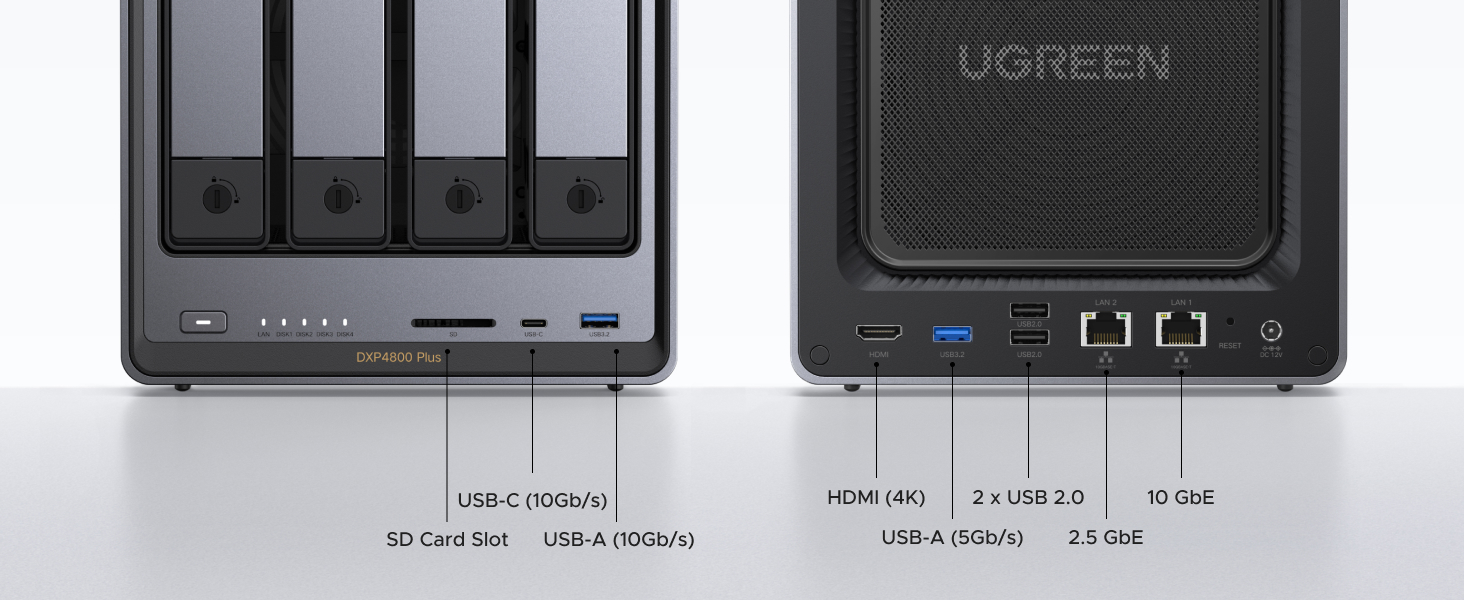
| Ethernet | 2x 10GbE + 2x 5GbE | 1x 10GbE + 1x 2.5GbE |
| M2 slots | 4 | 2 |
| Raid | RAID 0, RAID 1, RAID 5, RAID 6, RAID 10, JBOD | RAID 0, RAID 1, RAID 5, RAID 6, RAID 10, JBOD |
| Release | 2024 | 2024 |
Sources — ASUSTOR Lockerstor 4 Gen3 (AS6804T): asustor.com (verified 2026-06-15). UGREEN NASync DXP4800 Plus: ugreen.com (verified 2026-06-15).
Where the two actually differ on the specs we track (4 of 7). Matching specs are omitted.
Sourced tester consensus for each — the "what people who used it think" layer, not just specs.
Only one whitelisted tester (TechRadar) published a hands-on review of this exact model. TechRadar rates it 4/5, praising its AMD Ryzen Embedded V3C14 CPU with ECC DDR5 memory, up to 30GbE of network bandwidth and mature ADM 5.0 software, but flags the steep ~$1,300 price (nearly double the Gen 2), the missing GPU, and M.2 slots limited to a single PCIe lane. (1 sourced review, 1 lab-tested.)
Praised: Powerful AMD Ryzen Embedded V3C14 CPU paired with ECC DDR5 memory; Huge network bandwidth: dual 10GbE plus dual 5GbE and USB 4.0 direct connection; Mature, feature-rich ADM 5.0 software with an excellent app selection.
Flagged: Expensive for a four-bay NAS (~$1,300), nearly double the Gen 2 price; No GPU, which hurts Plex/video transcoding; M.2 slots limited to a single PCIe lane; trays require tools (not tool-less).
Only one whitelisted hands-on tester (TechPowerUp) yielded usable review prose for this exact model and year (DXP4800 Plus, Apr 2024). All measured values and quotes were verified verbatim against the review's Power/Noise/Thermals and Value/Conclusion pages. TechPowerUp praised the hardware, 10GbE and value, but flagged immature UGOS Pro software, inconsistent performance and thermal issues driving fan noise. (1 sourced review, 1 lab-tested.)
Praised: Strong hardware for the price: 10GbE plus 2.5GbE, Pentium Gold 8505, 8GB DDR5, OS on SSD, easy RAM/M.2 access; Solid build quality and generally quiet during normal operation; Standout value, especially at Kickstarter pricing.
Flagged: UGOS Pro software still early: lacks features and limited native apps; Inconsistent performance across tests (e.g. RAID 1 beating RAID 0); Thermal issues: CPU hit 100 C, which pushes fan noise high.