
Corsair
Corsair 4000D Airflow
$104.99Cheaper
Released 2020-09
Best PC Cases · head-to-head
A sourced, side-by-side comparison. Corsair 4000D Airflow is cheaper at $104.99. Every spec and price links to its source.
Corsair
$104.99Cheaper
Released 2020-09
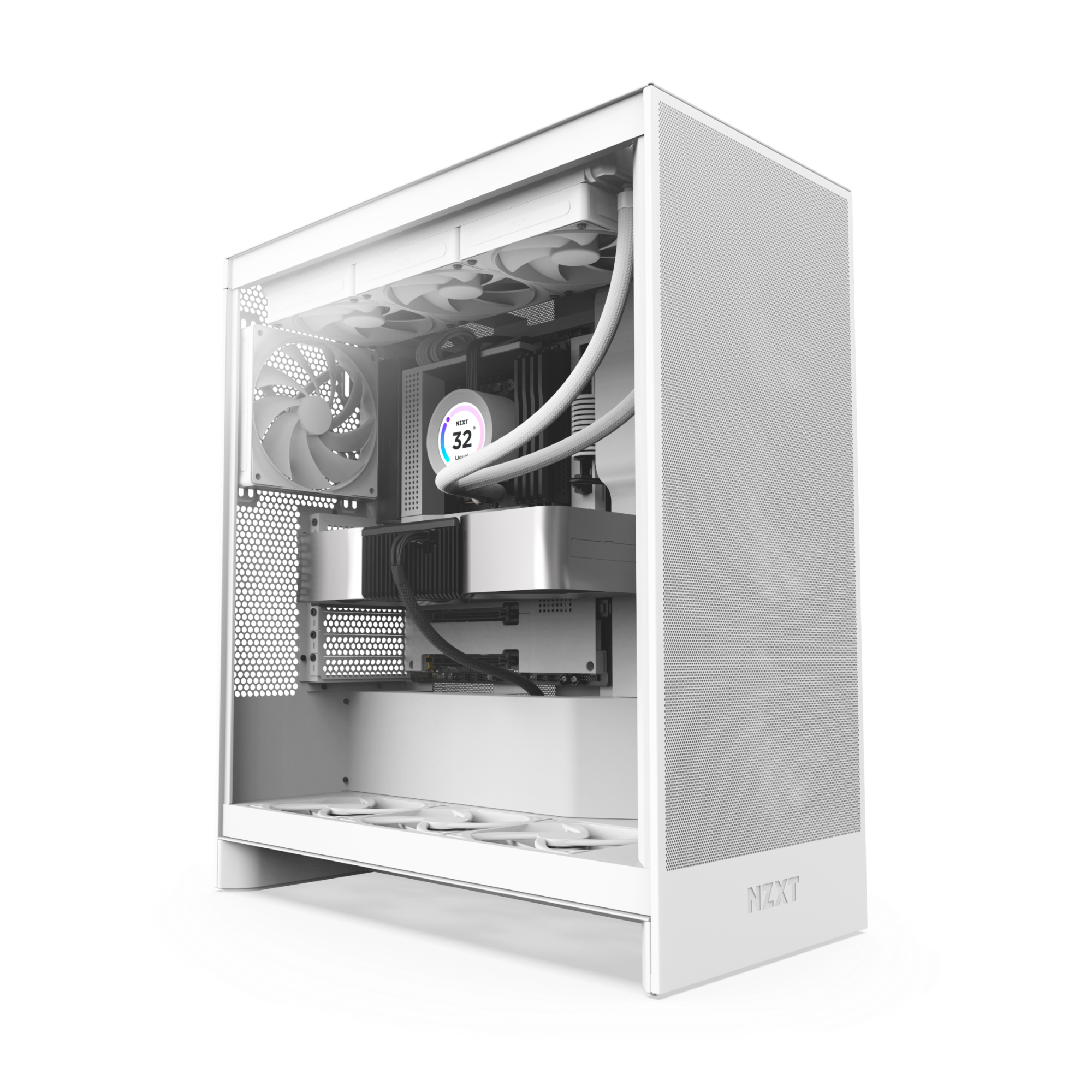
NZXT
$129.99
Released 2024
On the specs we track, they're closely matched. The Corsair 4000D Airflow is the cheaper at $104.99.
As an Amazon Associate we earn from qualifying purchases. Prices verified at capture; live price may differ.
✓ marks the stronger figure where "more" — or "less", for price and weight — is unambiguously better.
| Spec | Corsair 4000D Airflow | NZXT H7 Flow (2024) |
|---|---|---|
| US price | $104.99 | $129.99 |
| Brand | Corsair | NZXT |
| Released | 2020-09 | 2024 |
| Form factor | Mid-Tower (ATX/mATX/ITX/E-ATX up to 277 mm) | Mid-Tower (ATX/mATX/ITX/E-ATX) |
| Max GPU length (mm) | 360 | 410 |
| Max cooler height (mm) | 170 | 185 |
| Included fans | 2 x 120 mm AirGuide | 3 x 120 mm F120Q (non-RGB variant) |
| Radiator support | Front: 360/280/240 mm; Top: 240 mm (2x120) or 280 mm (2x140); Rear: 120 mm | Front: 420 mm; Top: 360 mm; Rear: 140 mm |
| Side panel | Tempered Glass (slide-on/slide-off) | Tempered Glass (dark tint on Black; ultra-clear on White) |
| Dimensions (mm) | 453 x 230 x 466 | 468 x 244 x 544 |
| Release | 2020-09 | 2024 |
Sources — Corsair 4000D Airflow: corsair.com (verified 2026-06-23). NZXT H7 Flow (2024): nzxt.com (verified 2026-09-21).
Where the two actually differ on the specs we track (7 of 7). Matching specs are omitted.
Sourced tester consensus for each — the "what people who used it think" layer, not just specs.
Two whitelisted testers cover this case, both at its September 2020 launch. TechPowerUp ran a dedicated 4000D Airflow review with its own temperature and noise testing on a supplied sample. Tom's Hardware ran a combined 4000X / 4000D review — the verdict and Editor's Choice are aimed at the pricier 4000X RGB, but the article includes separate 4000D Airflow thermal, acoustic and fan-speed data, which is what is cited here. Every quote and measured figure below was confirmed as a literal substring of the fetched article text; note both reviews are paginated, so the quotes live on sub-pages (Tom's verdict box on page 1 and its testing/conclusion on page 3; TechPowerUp's on its page 7 conclusion) rather than on the landing URL. Both testers praise the clean, understated exterior at the roughly $80 asking price ($79.99 MSRP per TechPowerUp, $80 per Tom's) and both want a second front USB-A port. Only Tom's produced measured cooling and acoustic results. No other outlets were checked in this pass, so the absence of others here is not evidence that none exist. (2 sourced reviews, 2 lab-tested.)
Praised: Clean, understated minimalist exterior with a solid feel for the roughly $80 asking price; Good value against competitors — Tom's calls the small Corsair premium well worth it, TechPowerUp calls it a beautiful and capable case for the price; Practical build details that ease assembly and cable routing (side panels that unhook and swing out, Velcro cable channel, plentiful zip-tie anchors).
Flagged: Only one front USB-A port; both testers wanted a second USB 3.0; Heavily tinted glass side panel hides non-RGB hardware — TechPowerUp calls the tint too heavy, Tom's notes it as a deliberate trade-off it is willing to accept; Liquid-cooling constraints — TechPowerUp says support is not as vast as other ATX cases; Tom's warns thick front radiators won't clear the PSU shroud cutout and the top is limited to 280 mm.
One whitelisted tester's quotes survived verification. Tom's Hardware tested this exact model (H7 Flow 2024) and rates it a solid, airflow-focused mid-tower that is very easy to build in, with room for up to 10 fans and large radiators, but flags conservative styling, no dust filters, and the need to add your own fans to exploit the improved airflow. A TechPowerUp review of the same case was dropped because only its intro page could be fetched, so none of its conclusion quotes could be verified. Numeric temp and noise results sit in image charts, so no measured values could be extracted verbatim. (1 sourced review, 1 lab-tested.)
Praised: Super easy to build in, with room for up to 10 fans and large radiators; Mesh-front, airflow-oriented design keeps thermals solid.
Flagged: Design feels a bit boring; NZXT played it safe with the update; Ships without enough fans; you must add your own to exploit the airflow; No dust filters.