
Sennheiser
Sennheiser Profile Wireless
—
Released 2024-10
Best Wireless Mic Systems · head-to-head
A sourced, side-by-side comparison. Saramonic Ultra is cheaper at $239. Every spec and price links to its source.
Sennheiser
—
Released 2024-10
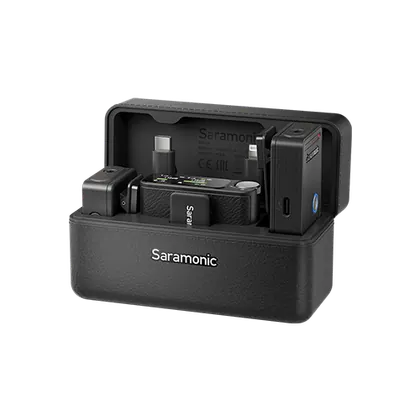
Saramonic
$239
The Sennheiser Profile Wireless wins 1 of the 1 specs we compare head to head; the other wins 0.
As an Amazon Associate we earn from qualifying purchases. Prices verified at capture; live price may differ.
✓ marks the stronger figure where "more" — or "less", for price and weight — is unambiguously better.
| Spec |  Sennheiser Profile Wireless Sennheiser Profile Wireless |  Saramonic Ultra Saramonic Ultra |
|---|---|---|
| US price | — | $239 |
| Brand | Sennheiser | Saramonic |
| Released | 2024-10 | — |
| Rf band type | 2.4GHz+BT | 2.4GHz |
| Transmitter count | 2 | 2 |
| Range meters | — | 300 |
| Tx battery life (hr) | 7 | 6 |
| Total battery (hr) | — | 18 |
| Onboard recording (hr) | 30 | — |
| Bit depth float | Yes | Yes |
| Latency (ms) | 8 | 25 |
| Max spl (dB) | 113 | 130 |
| Noise cancellation | No | Yes |
| Output interface | USB-C | — |
| Weight grams tx | 27 | 35 |
Sources — Sennheiser Profile Wireless: sennheiser.com (verified 2026-07-11). Saramonic Ultra: saramonic.com (verified 2026-07-11).
Where the two actually differ on the specs we track (6 of 12). Matching specs are omitted.
Sourced tester consensus for each — the "what people who used it think" layer, not just specs.
Three whitelisted outlets — TechRadar, Tom's Guide and SoundGuys — each reviewed this exact model hands-on (two weeks, a week of recording tests, and a week respectively) but published no lab measurements. All praise the charging-bar design that doubles as a handheld mic, the app-free/auto-pairing setup and automatic backup recording as a safety net. Sound quality splits them: excellent to TechRadar, merely good-enough to Tom's Guide, and clear/competent to SoundGuys (7.8/10). (3 sourced reviews, 3 lab-tested.)
Praised: Charging bar design that doubles as a handheld/broadcast mic and neatly stores every component; Easy, app-free / auto-pairing setup with universal connectivity (USB-C, Lightning, cold shoe, TRS); Automatic backup/onboard recording (16GB per transmitter) as a safety net against signal drops.
Flagged: No active noise cancellation, so background noise leaks through in loud environments; No 32-bit float recording, unlike the pricier DJI Mic 2 / Rode Wireless Pro; Sound trails similarly priced rivals (Shure MoveMic 88+, DJI Mic 2) on warmth.
Only one whitelisted tester (TechRadar) published a hands-on Saramonic Ultra review, based on a week of real-world use with an iPhone 13 and Lumix GH6. It rates the kit a viable, affordable pro-friendly option, praising crisp customizable 24-bit audio (Vocal Boost adds heft), 32-bit float onboard recording, timecode support and rain-proof IPX5 transmitters, but flags weak noise cancelling that still leaves traffic and wind audible at the top setting. No lab measurements were taken. (1 sourced review, 1 lab-tested.)
Praised: Crisp, customizable 24-bit audio; Vocal Boost adds heft and body to speech; Pro features included: 32-bit float onboard recording and timecode support; IPX5 rain-proof transmitters, uncommon among rival wireless mics.
Flagged: Weak noise cancelling; traffic noise still loud even at top setting; Charging case has no room for windshields or cables; Only sold as a two-transmitter kit; no Bluetooth and no backup/safety recording.