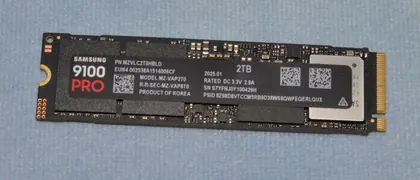
Samsung
Samsung 9100 Pro
$339.99
Released 2025-03
Best Internal Ssds · head-to-head
A sourced, side-by-side comparison. Seagate FireCuda 540 is cheaper at $189.99. Every spec and price links to its source.
Samsung
$339.99
Released 2025-03
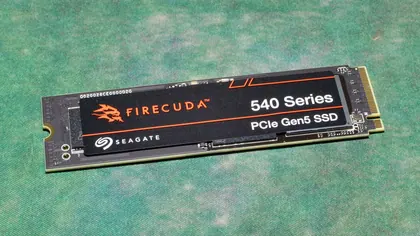
Seagate
$189.99Cheaper
Released 2023
The Samsung 9100 Pro wins 2 of the 2 specs we compare head to head; the other wins 0. The Seagate FireCuda 540 is the cheaper at $189.99. Get the Samsung 9100 Pro for the stronger spec sheet, the Seagate FireCuda 540 to spend less.
As an Amazon Associate we earn from qualifying purchases. Prices verified at capture; live price may differ.
The numbers that decide it, drawn to scale — longer bar wins, the accent bar is the stronger figure.
✓ marks the stronger figure where "more" — or "less", for price and weight — is unambiguously better.
| Spec |  Samsung 9100 Pro Samsung 9100 Pro |  Seagate FireCuda 540 Seagate FireCuda 540 |
|---|---|---|
| US price | $339.99 | $189.99 |
| Brand | Samsung | Seagate |
| Released | 2025-03 | 2023 |
| Capacity options (TB) | 1,2,4,8 | 1, 2 |
| Form factor | M.2 2280 | M.2 2280 |
| Interface | PCIe 5.0 x4 NVMe | PCIe 5.0 x4 NVMe |
| Seq read (Mbps) | 14800 | 10000 |
| Seq write (Mbps) | 13400 | 10000 |
| Random read kiops | 2200 | — |
| Random write kiops | 2600 | — |
| Nand type | TLC | TLC |
| Has dram cache | Yes | Yes |
| Endurance tbw | 600 | 1000 |
| Warranty years | 5 | 5 |
Sources — Samsung 9100 Pro: samsung.com (verified 2026-10-20). Seagate FireCuda 540: seagate.com (verified 2026-07-11).
Where the two actually differ on the specs we track (4 of 11). Matching specs are omitted.
Sourced tester consensus for each — the "what people who used it think" layer, not just specs.
Three whitelisted labs (Tom's Hardware, TechPowerUp, StorageReview) hands-on-tested the Samsung 9100 Pro, Samsung's first PCIe Gen5 consumer SSD, and agree it is among the fastest and most power-efficient consumer Gen5 drives, with record sequential reads of 14.2 GB/s (TechPowerUp) and 14,600 MB/s (StorageReview). Tom's Hardware and TechPowerUp temper the praise: both flag the premium price and frame the drive as a refined last-generation solution rather than revolutionary, and TechPowerUp additionally documents a sharp post-SLC-cache write drop (to 1.3 GB/s) and throttling without a heatsink. StorageReview is the most upbeat, calling its pricing competitive and the drive one of the most capable on the market. HotHardware was excluded as non-whitelisted. Tom's Hardware's page 2/3 benchmark figures (SLC-cache write, post-cache write, temperature) were not present on the review page we read and were dropped as unverifiable. (3 sourced reviews, 3 lab-tested.)
Praised: Record-setting sequential read; fastest consumer SSD in their tests; Excellent real-world, all-around and gaming performance; Strong power efficiency for a Gen5 drive.
Flagged: Highest / premium price among Gen5 drives; Needs a heatsink; bare drive can throttle under sustained load; Not revolutionary — an evolution of last-gen / best Gen4 tech.
Three whitelisted testers hands-on benchmarked the 2 TB FireCuda 540: Tom's Hardware and StorageReview at its 2023 launch, and TechPowerUp in a 2025 re-review. Consensus: a fast PCIe 5.0 drive with high sequential throughput, class-leading sustained/full-drive write speeds, and a standout support package (high TBW endurance plus 3-year data recovery), offset by poor power efficiency, high heat, and a hard requirement for a heatsink to avoid throttling. Both later-lens findings and StorageReview's enterprise tests show it only marginally leads top Gen 4 drives in real use and is weak in some write workloads. (3 sourced reviews, 3 lab-tested.)
Praised: High sequential throughput / impressive transfer rates; Class-leading sustained and full-drive write performance; Strong warranty, high TBW endurance and 3-year data recovery service.
Flagged: Poor power efficiency and high heat output; Requires cooling; throttles without a heatsink; Does not fully leverage Gen 5 - only marginally faster than top Gen 4 drives in real use, and weak in some write tests.