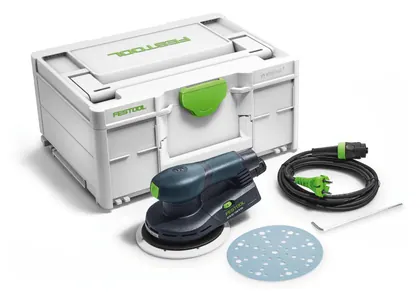
Festool
Festool ETS EC 150/5 EQ
$649
Best Random Orbital Sanders · head-to-head
A sourced, side-by-side comparison. Bosch GET75-6N is cheaper at $389. Every spec and price links to its source.
Festool
$649
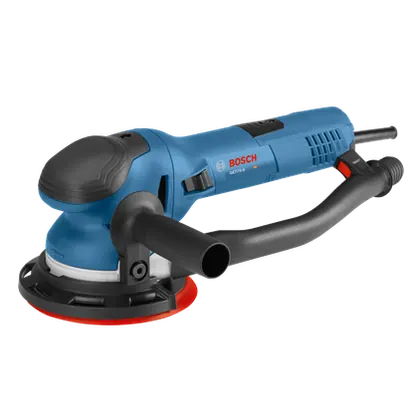
Bosch
$389Cheaper
The Festool ETS EC 150/5 EQ wins 1 of the 1 specs we compare head to head; the other wins 0. The Bosch GET75-6N is the cheaper at $389. Get the Festool ETS EC 150/5 EQ for the stronger spec sheet, the Bosch GET75-6N to spend less.
As an Amazon Associate we earn from qualifying purchases. Prices verified at capture; live price may differ.
✓ marks the stronger figure where "more" — or "less", for price and weight — is unambiguously better.
| Spec |  Festool ETS EC 150/5 EQ Festool ETS EC 150/5 EQ |  Bosch GET75-6N Bosch GET75-6N |
|---|---|---|
| US price | $649 | $389 |
| Brand | Festool | Bosch |
| Released | — | — |
| Power source | corded | corded |
| Pad diameter (in) | 6 | 6 |
| Orbit diameter (mm) | 5 | — |
| Oscillations per minute max | 10000 | 7300 |
| Variable speed | Yes | Yes |
| Amperage | — | 7.5 |
| Voltage | — | — |
| Dust collection type | vacuum-port | vacuum-port |
| Weight (lb) | 2.6 | 5.7 |
| Vibration ms2 | — | — |
| Noise level (dB) | — | — |
Sources — Festool ETS EC 150/5 EQ: festoolusa.com (verified 2026-09-28). Bosch GET75-6N: boschtools.com (verified 2026-07-11).
Where the two actually differ on the specs we track (2 of 11). Matching specs are omitted.
Sourced tester consensus for each — the "what people who used it think" layer, not just specs.
One whitelisted hands-on review — Pro Tool Reviews' month-long shop test — covers this exact model (the reviewer explicitly puts the ETS EC 150/5 through real furniture work). It scores the tool 9.8/10, praising electronic vibration control, smoothness rivaling pneumatic Dynabrade sanders, powerful Multi-Jetstream dust extraction and the instant pad brake, faulting only the absence of a variable-speed paddle and noticeable added weight on vertical surfaces. No lab measurements were reported. (1 sourced review.)
Praised: Electronic vibration control makes a world of difference; as smooth as pneumatic Dynabrade sanders over a full day with no hand numbness; Powerful Multi-Jetstream dust extraction — suction strong enough to stick the sander to a vertical surface; Instant pad brake stops the pad the moment you power off, so you can set it down without leaving swirl scratches.
Flagged: No variable-speed paddle like a pneumatic sander — speed adjusts only via a dial; Added weight versus a pneumatic sander is noticeable on vertical surfaces.
Only one whitelisted tester covers the Bosch GET75-6N: Pro Tool Reviews, and its December 2019 piece is a hands-off preview, not a lab test, so there are no measured results. It praises the robust dual-mode Turbo removal, constant speed under load, and sub-Makita/Festool pricing, but defers judgment on whether Turbo truly replaces a belt sander. Non-whitelisted blogs were excluded. (1 sourced review.)
Praised: Robust dual-mode performance, with Turbo mode rated for 3X faster stock removal than standard random orbit; Maintains a constant speed under load so pressure changes do not bog it down; Priced a little below Makita and well below Festool for the 6-inch model.
Flagged: Reviewer withholds a verdict on whether Turbo mode can actually replace a belt sander; New model's gain mainly closes the gap to the tool's own Turbo mode rather than leaping past rivals.